
Willow Launches AI-Powered NDIS Compliance Platform Built for Australian Disability Providers
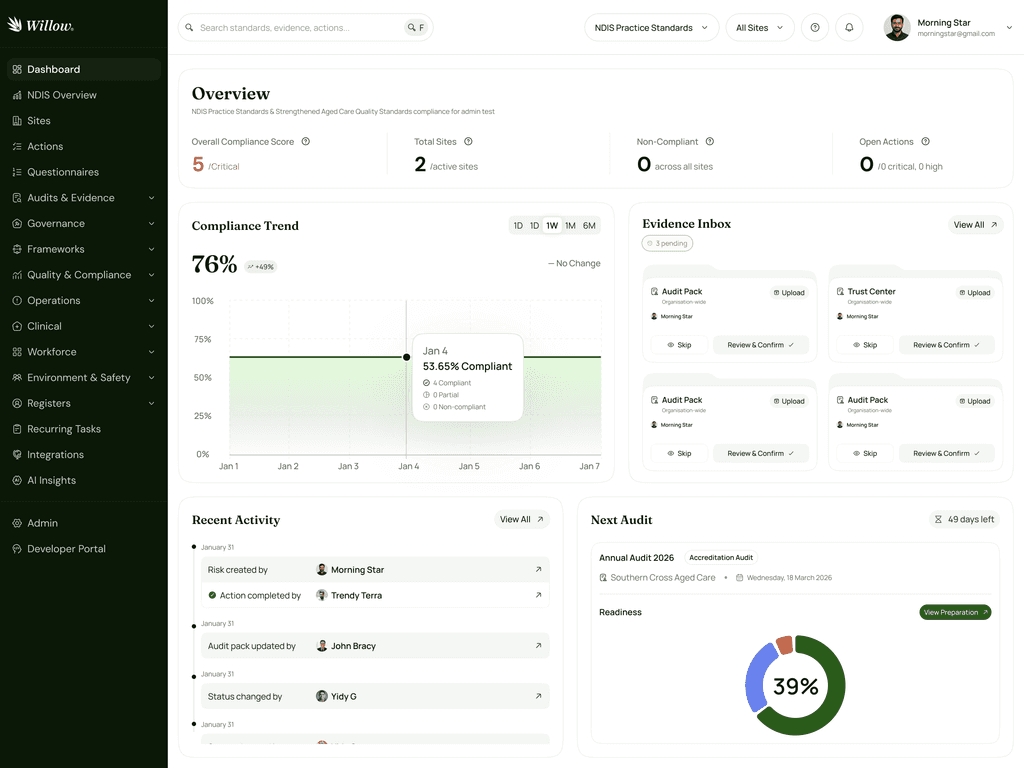
Sydney, Australia - 9 March, 2026 - Willow, an AI-powered compliance intelligence platform for regulated care organisations, today announced the expansion of its Australian platform focus to include NDIS providers, with dedicated support for the NDIS Practice Standards, incident management, behaviour support and audit readiness. Willow is designed to help disability service providers move away from fragmented spreadsheets, folders and manual compliance workflows, replacing them with a live compliance operating system built for real-world regulatory demands. Willow’s internal product documentation describes the platform as a compliance intelligence layer for aged care, healthcare and disability service organisations, with the NDIS Practice Standards included among its supported Australian frameworks.
Across the NDIS sector, compliance has become an increasingly operational issue rather than a once-audit-year exercise. The NDIS Practice Standards set the quality standards that registered NDIS providers must meet, and are structured across a core module, supplementary modules for higher-risk supports, and a verification module for lower-risk providers. The verification module alone covers human resource management, risk management, complaints management and resolution, and incident management.
At the same time, registered providers must maintain incident management systems and report certain serious incidents and unauthorised restrictive practices to the NDIS Commission. The Commission states that all NDIS providers should have an incident management system, while registered providers must have one as part of their registration conditions and must report certain incidents to the Commission.
For many providers, especially those operating lean teams across multiple service lines or locations, this creates a serious administrative burden. Evidence may sit across HR systems, care platforms, shift systems, training files, complaints logs, staff records, behaviour support documentation and email trails. Audit preparation can become reactive, slow and highly manual.
Willow was built to change that.
Rather than acting as another document repository, Willow functions as a compliance intelligence layer above a provider’s existing systems. It aggregates compliance data through integrations, uploads and CSV imports, uses AI to analyse and suggest evidence-to-requirement mappings, tracks assessments and remediation actions, and generates audit-ready outputs. Willow’s own documentation describes the platform as an evidence reader and orchestrator rather than a frontline system of record.
“NDIS providers do not need more admin for the sake of admin,” said a Willow spokesperson. “They need a smarter way to manage NDIS compliance, reportable incidents, restrictive practices, evidence and audit readiness without forcing quality teams to stitch everything together manually. Willow is built to turn compliance into a live operating system, not a folder exercise.”
Willow is launching with support for a wide range of NDIS compliance use cases, including:
NDIS Practice Standards mapping across modules and requirements
AI-powered evidence classification and requirement mapping
incident and complaint register workflows
remediation actions and overdue tracking
policy management linked to standards and evidence
staff training and credential tracking
site or service-level compliance dashboards
audit pack generation and readiness scoring
board and executive-level oversight reporting
integration and CSV-based evidence ingestion from existing systems
These capabilities align with Willow’s current architecture, which includes dashboard intelligence, evidence management, assessments, action tracking, governance modules, audit packs, staff and training registers, and AI-powered risk and gap detection.
One of the biggest pain points in the NDIS sector is incident and restrictive practice governance. The NDIS Commission defines a reportable incident as an act or event that has happened, or is alleged to have happened, in connection with delivering NDIS supports or services. The Commission also states that restrictive practices are a priority area, with a focus on protecting the rights of people with disability, improving the quality and safety of positive behaviour support, and reducing and eliminating restrictive practices. It regulates five types of restrictive practices: seclusion, chemical restraint, mechanical restraint, physical restraint and environmental restraint.
Willow’s platform is designed to help providers bring these obligations into the same compliance environment as their broader governance activities. Instead of managing incidents, behaviour support evidence, training records, complaints, policies and audit documentation in separate places, teams can connect them inside one structured system with traceability, workflow and oversight. Willow’s product materials show dedicated incident, complaint, staff, training and credential registers, plus audit preparation workflows and an auditor portal for controlled access to evidence.
That matters even more as the sector moves through ongoing regulatory change. The NDIS Commission has already announced that mandatory registration for supported independent living providers will begin from 1 July 2026, signalling a tighter compliance environment for supported accommodation services. In practice, that means stronger systems, cleaner evidence, better incident oversight and more continuous visibility are becoming more valuable, not less.
Willow believes this creates the need for a new category of software in disability services: not care delivery software, not consulting wrapped in a portal, and not static document storage, but an AI-native compliance orchestration platform purpose-built for regulated care. Willow’s internal strategy documents describe the business as a compliance orchestration and intelligence platform and state that there are no direct global competitors positioned as AI-native healthcare compliance orchestration.
For NDIS providers, the practical outcome is straightforward. Compliance becomes easier to structure, easier to evidence, easier to review and easier to govern. Quality teams can see what evidence exists, what is missing, what actions are overdue, where incident trends are emerging and how prepared the organisation is for audit or verification. Executives and board members get a clearer line of sight into risk, assurance and operational compliance.
Willow is currently working with Australian providers that want a more modern and scalable way to manage NDIS compliance, incident management, restrictive practice governance, policy control and audit readiness inside one platform.
Media Contact
Company Name: Willow Compliance Pty Ltd
Contact Person: James Driscoll
Email: Send Email
Country: Australia
Website: https://heywillow.ai
Press Release Distributed by ABNewswire.com
To view the original version on ABNewswire visit: Willow Launches AI-Powered NDIS Compliance Platform Built for Australian Disability Providers
Information contained on this page is provided by an independent third-party content provider. XPRMedia and this Site make no warranties or representations in connection therewith. If you are affiliated with this page and would like it removed please contact [email protected]
