
SolarEnergies.ca Updates BC Solar Guide as BC Hydro Pushes Home Solar Adoption
Halifax, Nova Scotia - March 06, 2026 - PRESSADVANTAGE -
SolarEnergies.ca has released an updated British Columbia solar guide, noting that the latest revision reflects a more careful look at the facts affecting homeowners across the province, from rebate rules and utility pricing to the closure of federal financing programs many homeowners still assumed were available.
https://www.youtube.com/watch?v=oBMy_fcq_C0
The update arrives as British Columbia’s solar market enters a more practical phase. Interest remains strong, but the sales pitch has changed. Lower hydro rates in B.C. still make the economics tighter than in provinces with higher power prices. At the same time, BC Hydro has kept public attention on self-generation by promoting rebates for eligible grid-connected solar panels and battery storage, framing those offers as a way for British Columbians to produce more of their own electricity, cut bills, and send clean power back to the grid.
According to SolarEnergies.ca, the revised guide was prepared after a fact check of several commonly repeated claims that continue to appear across Canadian solar content. The publication said the goal was simple: reduce confusion before homeowners request quotes, sign contracts, or budget around incentives that may no longer exist.
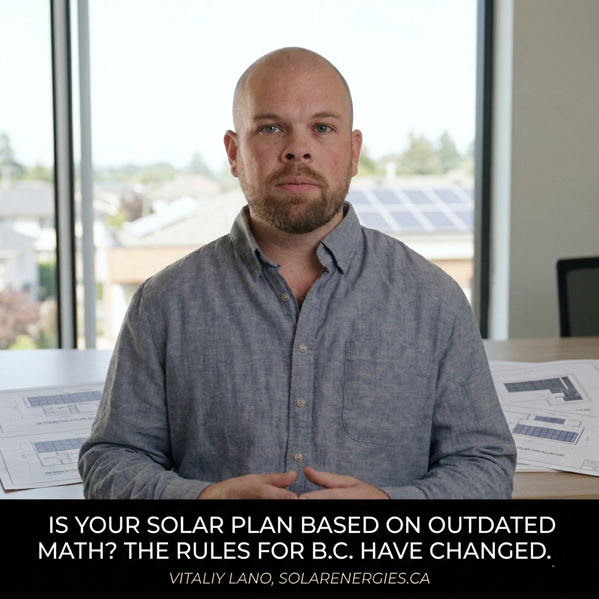
Vitaliy Lano, author and publisher at SolarEnergies.ca, said the update was necessary because too many homeowners are still planning solar projects based on outdated numbers. “A lot of people are reading old pages and getting the wrong picture,” Lano stated. “Some are still counting on federal loan access that has already closed. Others are still seeing old net metering payout figures and treating them like the current policy. That creates bad expectations before the first installer even shows up.”
The revised guide keeps one message at the center: solar in British Columbia can still make sense, but only when the math is tied to current rules. SolarEnergies.ca said BC Hydro’s residential rebate remains one of the clearest levers in the market, offering up to $5,000 for eligible solar installations, calculated at $1,000 per kilowatt and capped at 50 per cent of installed cost. The publication also pointed to BC Hydro’s process requirements, which require customers to work through the self-generation application and secure approval before moving ahead with a qualifying installation.
Lano commented that rebate language matters because many homeowners still treat rebate pages as general advertising instead of a ruleset. “The paperwork is part of the project,” Lano said. “If the system is purchased too early, if the application timing is wrong, or if a homeowner assumes every installer is automatically aligned with program requirements, the project can get more expensive fast.”
SolarEnergies.ca said one of the most important corrections in the updated guide concerns net metering payouts. The publication noted that BC Hydro’s older transitional 9.99-cent figure is still quoted online, even though the utility now describes annual surplus compensation for newer self-generation customers as a market-based price tied to Mid-Columbia pricing. That change matters because it shifts the value discussion away from oversizing a system for export and back toward matching solar production to household demand.
“B.C. is not a market where it makes sense to sell solar as an easy profit from surplus power,” Lano added. “The smarter approach is still right-sizing the system, using more of what the home produces, and treating bill stability as part of the value. That is a stronger and more honest case.”
The guide also addresses the wider policy shift left by the federal Canada Greener Homes programs. While many homeowners in British Columbia once paired provincial support with federal grant or loan planning, that landscape has changed. SolarEnergies.ca said the federal grant is closed, and the Canada Greener Homes Loan is also no longer open to new applicants, a change that removes one financing path from the conversation and puts more pressure on accurate quote comparisons, utility rebates, and household cash flow analysis.
Lano expressed concern that outdated financing references are still circulating in search results and local marketing pages. “People are still budgeting around support that is gone,” he said. “That does not mean solar stopped being worth a look. It means the project has to stand on current numbers, current rebates, and a current understanding of how long payback may really take.”
SolarEnergies.ca said the update also reflects a broader signal from the province’s electricity system. Even in a market known for relatively low hydro rates, utilities and policymakers are continuing to talk about electrification, self-generation, and new clean power supply. The publication said that context matters because the decision to install solar in British Columbia is now less about chasing a quick return and more about long-term control, resilience, and protection against future shifts in power costs.
“The old pitch was all about instant savings,” Lano suggested. “That is too thin for B.C. The stronger case is that a homeowner can cut exposure to future rate changes, lower grid dependence during daylight hours, and make the house more prepared for the next decade of electrification. That is a real argument. It does not need hype.”
In the updated guide, SolarEnergies.ca said homeowners should pay closer attention to system sizing, roof condition, electrical panel readiness, installer documentation, and the exact timing of rebate applications. The publication added that a low quoted price does not always mean a lower final project cost once panel upgrades, roof work, permitting, or wiring changes are included.
Lano said careful planning still gives homeowners room to move with confidence. “There is still a path here,” Lano stated. “The rebate helps. Demand is there. BC Hydro is clearly encouraging more self-generation. But homeowners need clean information first. A solar project should start with facts, not assumptions.”
SolarEnergies.ca said the revised British Columbia guide is intended to give readers a clearer baseline before they compare installers or make a final investment decision. For more information about solar energy in Canada and a free solar calculator, visit the company's website.
###
For more information about Solar Energies In Canada SEIC, contact the company here:
Solar Energies In Canada SEIC
Vitaliy Lano
2368680609
[email protected]
Information contained on this page is provided by an independent third-party content provider. XPRMedia and this Site make no warranties or representations in connection therewith. If you are affiliated with this page and would like it removed please contact [email protected]
