Traditional Institutions Must Embrace Flexibility and Innovation to Reclaim Adult Education Market Share
Institutions face competition from corporate training providers and alternative credentialing platforms, but they retain unique advantages in trust, academic rigor and community connections.
Corporate providers dominate: Recognizable brands have captured significant market share in adult learning.
Student preferences shifting: Higher education is seeing a rise in adults considering alternative, non-degree programs.
Technology gaps persist: Only institutions that have adopted modern platforms have the technological flexibility to meet modern learner expectations.
Institutions can compete by embracing microcredentials, implementing flexible technology and building partnerships that align with continuing education trends.
Where colleges and universities once held a monopoly on post-secondary learning, a diverse ecosystem of alternative providers now competes for the attention of adult learners seeking to advance their careers.
Higher education faces competition from companies such as IBM, Google, Salesforce, Microsoft, Amazon and Walmart. Meanwhile, 54% of prospective students are interested in compressed courses or certification programs due to the current economy, compared to 43% of students seeking traditional degrees.
Amid the competition, this shift presents an opportunity for traditional higher education. The question is whether colleges and universities will adapt quickly enough to keep up with continuing education trends.
What Are Alternative Education Providers Doing Right?
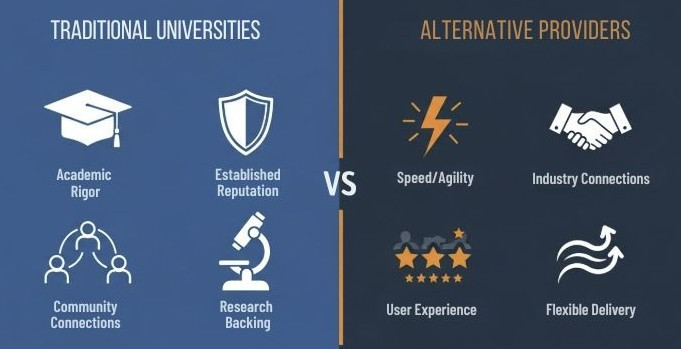
The success of alternative providers stems from their ability to address pain points that traditional institutions have long ignored. Third-party providers are intentionally structured to work with employers because they have streamlined processes for communicating with businesses, can quickly customize curricula and can provide data and evidence of the program's effectiveness.
These providers excel in several key areas that traditional institutions must emulate to remain competitive in the lifelong learning space:
Speed and Agility in Program Development
While universities often require months or years to develop new programs, alternative providers can launch courses in weeks. Google can rapidly identify emerging IT skills gaps and create corresponding certification programs because they operate in the technology space daily. Universities, conversely, navigate complex approval processes and academic governance structures that slow innovation.
Direct Industry Connections
Employers are experiencing a skills gap that leaves them less competitive in a challenging labor market. Many feel their workers don't have the right skills for the job or that those specific skills are being outpaced by industry-wide changes. Alternative providers maintain direct pipelines to industry needs. LinkedIn Learning knows which skills are trending based on job posting data. Corporate universities intimately understand their specific workforce development requirements.
Consumer-Grade User Experience
Adult education market trends show that learners expect seamless, intuitive experiences. Alternative providers invest in user experience design, creating solutions that feel more like entertainment platforms than traditional learning management systems. This attention to user experience translates directly into higher engagement and completion rates.
How Can Higher Education Institutions Fight Back?
Despite these competitive pressures, traditional institutions possess significant advantages that they can leverage to compete effectively in the continuing education market.
What Are Your Institutional Strengths?
Institutions maintain several advantages that alternative providers can't easily replicate. The established reputations of many colleges as trusted sources of knowledge, skill and technical preparations could be an asset if they brought microcredentials to market at a greater scale.
Universities offer academic rigor, research-backed curricula and established credentialing authority that employers and learners value. They also possess deep community connections, alumni networks and regional knowledge that corporate providers lack.
How Can You Embrace Microcredentials Strategically?
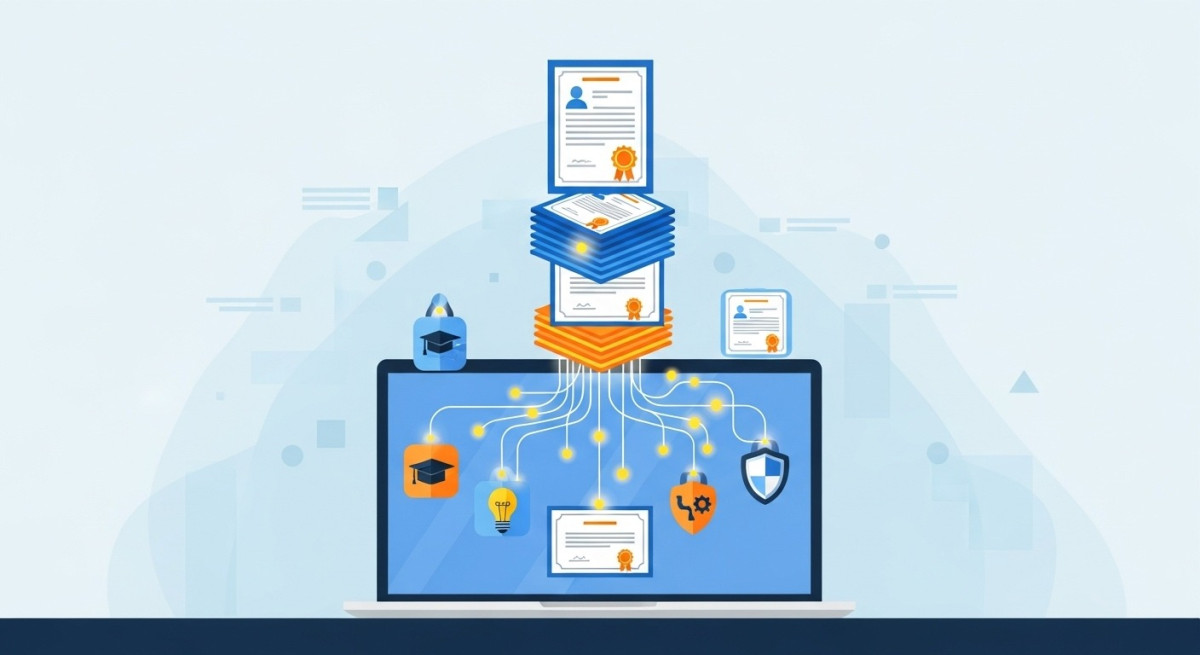
The number of available microcredentials doubled between 2021 and 2022, and that number continues rising. Successful microcredential implementation requires three critical elements:
Stackable Pathways: Design microcredentials that build toward larger credentials or degrees. Learners can progress at their own pace while maintaining engagement with your institution over time. More than 50% of institutions already offer microcredentials, and over four-fifths plan to increase their offerings by 2029.
Industry-Relevant Content: Partner with local and regional employers to ensure your microcredentials address real skill gaps. Institutions succeeding in the microcredential space prioritize employer input during curriculum development rather than treating partnerships as validation exercises.
Quality Assurance: Leverage your institution's academic reputation by maintaining rigorous standards while embracing flexibility. In a market where trust in providers of microcredentials is an issue, universities are among the most trusted, as they already have the authority to award degrees.
What Technology Investments Should You Prioritize?
The LMS market is expected to reach $70.83 billion by 2030, driven by non-traditional learner needs. Modern LMS platforms specifically designed for adult learners offer flexible scheduling, competency-based progression and integration with workforce development tracking.
Technology investments should focus on creating seamless user experiences that match the expectations continuing education trends have established:
Mobile-First Design: With 87% of households having and actively using digital devices, mobile learning apps provide essential accessibility for learners who study during brief time windows. Adult learners often study during commutes, lunch breaks or evening hours, making mobile accessibility vital.
Integrated Systems: Break down silos between continuing education and traditional academic programs. Top institutions use unified platforms that allow students to seamlessly transition between non-credit and credit offerings.
Data Analytics: Implement systems that provide real-time insights into learner engagement, completion rates and career outcomes. This data enables continuous program improvement and demonstrates value to both learners and employer partners.

How to Build Strategic Workforce Partnerships
Strategic workforce partnerships are an effective way for institutions to differentiate themselves from alternative providers while ensuring their programs remain relevant. These collaborations validate your curriculum while creating sustainable revenue streams and providing students with direct pathways to employment upon program completion.
How Do You Identify the Right Partners?
Employers who put intentionality around the continuum of education for their employees are seeing growth. However, not all partnerships provide equal value. Focus on building relationships with organizations that share your commitment to quality and learner success.
Look for employers who understand that workforce development is an investment, not an expense. These partners will collaborate on curriculum development, provide real-world learning opportunities and offer pathways for learner advancement within their organizations.
What Makes Partnerships Successful?
Effective workforce partnerships require flexibility and responsiveness. Traditional academic timelines don't align with business needs, so institutions must develop parallel processes for workforce-focused programming.
Successful partnerships also require clear communication about outcomes and expectations. Establish metrics for success, regular feedback loops and mechanisms for rapid adjustments based on changing industry needs.
The Role of Lifelong Learning
The concept of lifelong learning has evolved from an educational ideal to a business imperative. As traditional enrollment models face increasing pressure, institutions that can successfully engage learners across multiple career stages and life transitions will build more resilient revenue streams and stronger community connections.
How Can You Support the 60-Year Curriculum?
The shift toward a 60-year curriculum calls for new models that surpass traditional degree pathways. To support learners through continuous upskilling and evolving career needs, institutions must adapt how they deliver, credential and support education across a lifetime.
Institutions must think beyond traditional enrollment cycles and degree completion. Instead, view each learner as a potential lifelong customer who will return multiple times throughout their career for different types of education and training.
Supporting lifelong learning means creating flexible pathways that accommodate learners at different career stages. A recent graduate might pursue microcredentials for specialized skills, while a mid-career professional might need executive education, and a late-career worker might seek transition training for a second career.
What Systems Enable Lifelong Relationships?
Building lasting relationships with learners requires systems that can track and respond to individual career progression over decades. Consider maintaining alumni engagement, offering continuing education discounts and providing career transition support.
Technology platforms should enable learners to build comprehensive profiles that track their education, skills and career goals across multiple programs and years. This data allows for personalized recommendations and targeted outreach for relevant new offerings.
Overcoming Implementation Challenges
Even institutions that recognize the importance of continuing education often struggle with internal barriers to non-traditional programs. Successfully navigating these challenges requires both technological infrastructure improvements and cultural shifts that align traditional academic values with modern market realities.
What Barriers Must You Address?
Some higher ed staff report difficulty accessing critical business information, such as non-degree enrollment numbers, without consulting multiple departments or individuals. This lack of integrated data systems is a fundamental barrier to competing in the continuing education space.
Institutions also face cultural resistance to change. Traditional faculty may view continuing education as less prestigious than degree programs, while administrators might resist investing in non-traditional programming due to concerns about resource allocation or reputation. Overcoming these barriers requires clear communication about market realities and institutional sustainability, along with demonstrating how continuing education can enhance rather than diminish the academic mission.
How Do You Build Internal Support?
Creating institutional buy-in requires demonstrating the revenue potential and strategic importance of continuing education. While senior leadership at many institutions supports scaling non-degree courses and programs, this buy-in must include faculty, staff and academic departments who will be responsible for implementation.
Develop pilot programs that demonstrate success and build momentum for larger initiatives. Share data about market demand, revenue generation and learner outcomes to build support across the institution. Create incentive structures that reward faculty and staff participation in continuing ed programming, and establish clear pathways for career advancement that value work in non-traditional education sectors. Consider forming cross-campus committees that include representatives from both traditional academic units and continuing education divisions to foster collaboration and shared ownership of goals.
Future-Proofing Your Continuing Education Strategy
Institutions that invest in adaptable systems and forward-thinking approaches will be better positioned to capitalize on emerging opportunities and maintain competitive relevance.
How Will Technology Continue to Shape the Market?
Artificial intelligence has moved from experimental to essential in education, with student adoption of AI tools reaching 86%. Institutions that embrace AI and other emerging technologies will have advantages in creating personalized, efficient learning experiences.
The adult education market will continue evolving toward more personalized, on-demand learning experiences. Generative AI helps companies create courses faster, allowing for personalized learning at scale. For example, automatic competency mapping allows instructors to see how well they cover certain material and better assess student mastery levels.
What Trends Should Guide Your Planning?
Interest in non-degree programs has surged in recent years, rising from 34% in 2019 to 47% in 2022. That 38% jump far outpaces the modest 3% growth in undergraduate program interest. These trends suggest that continuing education will become increasingly central to institutional revenue and mission fulfillment.
Plan for a future where the majority of your learners are adults seeking specific skills rather than traditional students pursuing degrees. This shift requires fundamental changes in marketing, student services and program design.
Frequently Asked Questions
What are the biggest continuing education trends affecting higher education? The most significant trends include the rise of microcredentials and alternative credentials, increased demand for flexible online learning options, growing employer partnerships for workforce development and the shift toward skills-based rather than degree-based learning. These trends are driven by changing demographics, technology adoption and evolving job market requirements.
How can traditional colleges compete with corporate training providers? Colleges can leverage their established reputation, academic rigor and community connections while adopting the agility and user-focused approach of corporate providers. Key strategies include developing microcredential programs, streamlining program approval processes, investing in modern technology platforms and building strategic partnerships with local employers.
What role do microcredentials play in the future of continuing education? Microcredentials serve as a bridge between traditional education and immediate workforce needs. They allow institutions to offer flexible, stackable learning options that can lead to larger credentials while providing learners with immediate skill validation. Successful microcredential programs focus on industry-relevant content, maintain quality standards and create clear pathways for career advancement.
Why is technology investment crucial for continuing education success? Adult learners expect consumer-grade digital experiences similar to what they encounter in online services. Technology investments in mobile-friendly platforms, integrated systems and data analytics enable institutions to meet these expectations while providing personalized learning experiences and demonstrating program value.
Step Into the Future of Continuing Education
The future of continuing education belongs to institutions that can combine the trust and academic rigor of traditional higher education with the agility and user-centricity of alternative providers. By embracing microcredentials, investing in appropriate technology and building partnerships, colleges and universities can reclaim their position as leaders in lifelong learning.
The window for adaptation is narrowing, but opportunities remain for institutions willing to evolve. Modern Campus can help your institution build the technology infrastructure and strategic approach needed to compete with alternative providers while serving the evolving needs of adult learners.