IT Company in Idaho Breaks Down the Key Differences Between Good and Great MSPs
It’s easy to feel overwhelmed when comparing managed service providers. There are an estimated 150,000 managed service providers (MSPs) in the United States, and most of them offer very similar sales pitches. That’s why you need to drill into highly specific questions to ask an MSP to find out who they really are.
“A strong MSP partnership starts with understanding your business drivers because technology should be a tool for your strategic growth.” – Tavis Reche, President at Virtual IT
To make matters more complicated, every organization’s IT needs will vary. Sometimes, an MSP’s value is based on whether or not they are the right fit for your specific business needs, not whether they are a “good” or “bad” MSP. This nuance is why using a generic managed IT checklist isn’t the right approach.
In this article, an IT firm in Idaho helps you simplify the process by determining what you want in a managed IT provider and showing how to pinpoint the ideal MSP for your business needs.
How to Determine Your Managed Services Vendor Selection Criteria
1. Define Your Business Objectives
Start by listing what your business must achieve through managed IT services. Consider priorities such as uptime, data protection, scalability, or compliance. The goal is to connect your IT needs to measurable business outcomes.
Write these goals in specific terms, such as “reduce response time by 20%” or “improve network stability during seasonal spikes.” Clear objectives will anchor every later decision about your vendor criteria.
2. Identify Key Service Areas
Outline the core service categories that matter most to your organization. Examples might include cybersecurity, helpdesk support, cloud management, or strategic consulting.
Focus on relevance, not volume. Choose categories that directly affect daily operations or long-term goals. This process prevents you from overvaluing features that don’t serve your primary needs.
3. Evaluate Your Internal Capabilities
Assess your current IT strengths and weaknesses before comparing vendors. Identify which responsibilities you want to keep in-house and which would benefit from external support. Document current tools, team expertise, and gaps. Understanding your baseline helps you design criteria that fill real needs rather than duplicating existing capabilities.
4. Determine Performance Expectations
Define what “good performance” means for your business. Consider factors like issue response time, ticket resolution, reporting accuracy, and communication standards.
Translate expectations into measurable terms. For instance, you might require a provider that offers monthly technology reviews or real-time ticket tracking. These specifics guide future vendor discussions with clarity.
5. Define What a Cultural Fit Means to You
A strong partnership depends on shared values and communication style. Think about how your organization collaborates, how often you expect updates, and whether you prefer on-site or remote engagement.
Use this reflection to define what kind of working relationship feels effective for your team. Criteria based on culture often matter as much as technical ability. Research even shows that aligned cooperation creates a 61% variance in work performance.
6. Prioritize & Weigh Your Criteria
Once you’ve defined your categories, assign importance levels to each. For instance, security may rank higher than scalability for some organizations. This step converts your list into a decision-making tool. When comparing vendors, weighting helps you focus on what drives the most value rather than treating all factors equally.
Recommended MSP Qualifying Questions
As mentioned, every organization will have different priorities. Therefore, your technical questions for qualifying an MSP will be unique. Still, there are a few key questions that we recommend, no matter your organization’s idiosyncrasies. Here they are.
| Key Area | Question to Ask About The MSP | Why It Matters |
| Security Posture | Does the MSP’s website, services, or case studies highlight cybersecurity as a priority? | An MSP that leads with cybersecurity is more likely to have mature defenses built into its offerings. |
| Breadth of Services | Can the MSP manage multiple IT needs and offer a variety of services? | Providers with diverse services can better support evolving business requirements. |
| Client Matching Process | Does the MSP describe how they align businesses with the right specialists or tailor solutions to different needs? | Custom-fit support leads to solutions that better reflect your specific goals and IT challenges. |
| Scalability and Flexibility | Does the MSP seem equipped to scale with your business as it grows or changes direction? | A scalable provider can evolve with your organization, preventing costly transitions later. |
| Consistency and Audits | Does the MSP reference defined processes, reporting, or regular reviews of client systems? | Consistency and scheduled audits demonstrate reliability and proactive IT management. |
How to Choose a Managed Services Provider Based on Your Managed IT Services Checklist
1. Identify Potential Matches
Search for MSPs that advertise services aligned with your top priorities. Compare each provider’s public documentation, website content, and downloadable materials against your checklist. If their messaging and case studies consistently address your needs, they may be a strong match worth deeper review.
2. Examine Service Scope
Match your defined service categories against what each provider offers. Providers whose core offerings align with your operational gaps should move forward in your selection process. Those outside your scope can be deprioritized or removed.
3. Analyze Technology Support
Look for references to the platforms, vendors, and software ecosystems each MSP supports. Compare this with the technologies that you use in your business. Compatibility with your existing systems can prevent costly migrations or workflow disruptions. Providers using entirely different toolsets may not be worth pursuing further.
4. Evaluate Security Coverage
Apply your checklist’s security standards to review provider documentation for certifications, frameworks, and compliance statements. Eliminate vendors that cannot demonstrate alignment with your required standards. Early filtering here prevents wasted time later in the process.
5. Compare Costs
Although the lowest cost provider isn’t necessarily the best option, you understandably will still need to be realistic about your budget. There are ways you can balance quality without going too far out of your range.
Review pricing ranges, plan descriptions, or public estimates available from each provider. Prioritize the best service packages. Simply going with the lowest upfront cost may ironically become more expensive later if they can’t meet your expectations. By comparison, the right MSP can lower your overall IT costs by 25%-45%.
6. Build Your Initial Shortlist
Finally, gather the few providers that best match your criteria after these steps. Narrow down your list to around 3 to 5 candidates that make the most sense. These MSPs will be the ones that you will contact for a discovery call. A discovery call shortlist is much easier to manage than calling every potential MSP that you identified in step 1.
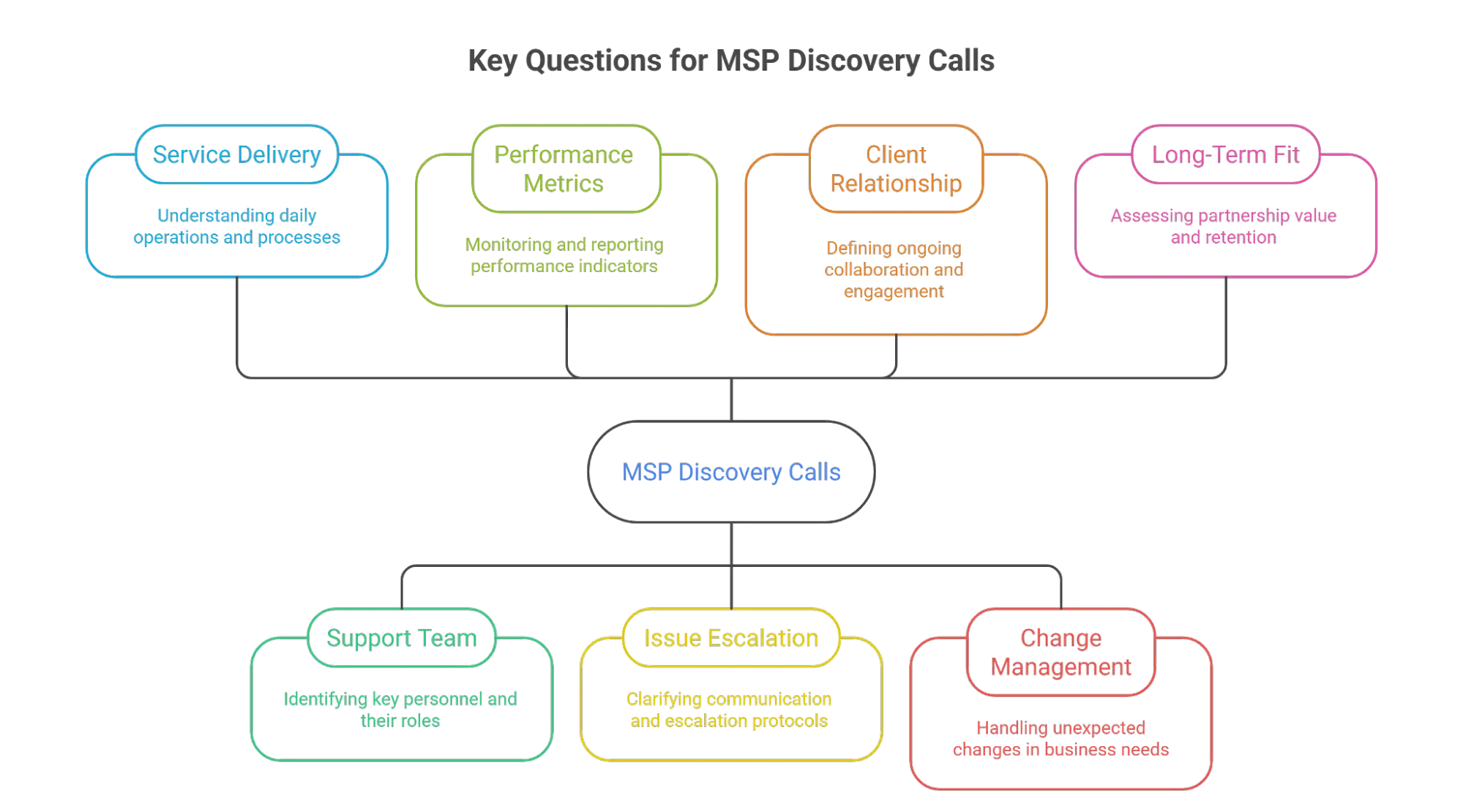
7 Key Questions to Ask During MSP Discovery Calls
1. How Do You Deliver and Manage Your Services?
Ask the provider to explain their daily service operations, including ticket intake, escalation, and resolution. Learn whether they use standardized processes or adapt to each client. This helps you evaluate how organized and predictable their service delivery will be.
2. Who Will Be Supporting Us?
Ask about who will handle your account, including day-to-day technicians, project leads, and strategic advisors. Verify their certifications, tenure, and familiarity with your type of environment. This ensures you’re working with a team capable of both technical execution and high-level planning.
3. What Metrics Do You Track?
Ask which performance indicators they monitor and how those metrics are shared with clients. Request an example report or dashboard to review. If they cannot share this, simply ask them to describe what it would look like.
Consistent reporting shows how accountable the provider is to service outcomes and how easily you can track their performance.
4. How Do You Escalate Issues?
Clarify communication channels, response times, and escalation protocols. Ask how they prioritize urgent issues and who you can contact directly in high-impact situations. This helps you assess whether their communication standards meet your expectations for speed and transparency.
5. What Does a Typical Client Relationship Look Like?
Request a clear picture of what ongoing collaboration feels like. Ask about the cadence of meetings, planning sessions, and who you’ll interact with most often. This helps you understand their client engagement model and whether it supports the level of involvement your business expects.
6. What Happens When Priorities Shift?
Discuss how they handle unexpected changes in business needs, such as growth, budget adjustments, or policy changes. You’re looking for flexibility and a structured approach to change management. Having one shows that they can adapt their strategy and resources without destabilizing your operations.
7. What Makes You a Long-Term Fit for Our Business?
Close by asking what differentiates them in client longevity or retention. Request real examples that illustrate how they sustain relationships beyond initial contracts. This open-ended question helps you gauge how seriously they view partnership value versus short-term technical support.
Find Out Whether a Trusted Idaho IT Firm Can Meet Your Managed Services Criteria
Once you’ve assessed your IT needs and identified what’s holding your business back, your next step is to turn those insights into action.
With Virtual IT, you receive a satisfaction-guaranteed SLA, flat monthly per-user pricing, no onboarding fees, and a flexible relationship. Our team performs regular audits and follows proven processes to keep your IT aligned with best practices while providing dependable, responsive support.
Choose a partnership based on transparency so that you can have more confidence in your IT. Contact a trusted Idaho IT firm today!