Higher Ed SaaS Solutions for Proactive Engagement
How Integrated Platforms Move Beyond Reactive Support to Anticipate Student Needs
Proactive higher ed SaaS solutions are revolutionizing student success by anticipating needs before problems arise.
Integrated lifecycle platforms connect academic, engagement, and communication data for comprehensive student insights
Engagement analytics identify patterns early, enabling timely interventions that prevent student challenges
Personalized communication systems guide students proactively rather than responding to crisis situations
Data-driven platforms allocate resources strategically based on predictive insights rather than reactive measures
Institutions implementing proactive student lifecycle management software see measurable improvements in retention, engagement, and operational efficiency.
The landscape of higher ed SaaS solutions has reached a critical turning point. While many platforms still operate reactively by responding to student actions after they occur, the most innovative institutions are implementing systems that anticipate student needs before challenges become critical.
With research from RAND Corporation showing that personalized learning approaches help students gain significant ground academically, with the largest gains occurring in the second year as systems mature, proactive approaches represent the next evolution in educational technology.
Student engagement directly correlates with retention outcomes, making anticipatory support systems essential for institutional success. This shift toward anticipatory support requires sophisticated data integration and analytics capabilities that transform how institutions understand and serve their student populations.
The Evolution from Reactive to Proactive Student Support
Traditional higher ed SaaS solutions operate on response models, addressing student needs after issues surface. A student stops attending classes, their advisor receives an alert. Course evaluations reveal learning difficulties, support resources get deployed. Financial aid deadlines approach, mass communications go out. While these responses provide value, they position institutions as constantly catching up rather than staying ahead.
Proactive higher ed SaaS solutions fundamentally change this dynamic by analyzing patterns across multiple data sources to identify trends before they become problems. These platforms examine engagement patterns, communication preferences, academic progress indicators, and behavioral signals to create comprehensive student profiles that inform preemptive interventions.
Modern institutions implementing integrated platforms report transformative improvements in their ability to support students effectively. Rather than waiting for crisis situations, staff receive insights that enable meaningful conversations during regular check-ins, targeted resource recommendations delivered at optimal moments, and strategic communication that guides students toward successful outcomes.
The distinction between reactive and proactive approaches becomes particularly evident during critical transition periods. Summer melt, course registration, financial aid processes, and career planning all benefit dramatically when institutions can anticipate challenges and provide relevant support before students feel overwhelmed or disconnected.
How Engagement Analytics Enable Predictive Student Support
The foundation of proactive student support lies in sophisticated engagement analytics that track interactions across multiple touchpoints. Student lifecycle management software with comprehensive analytics capabilities provides insights that enable institutions to understand not just what students are doing, but what they might need next.
Engagement analytics examine participation patterns in campus events, digital resource usage, communication response rates, and academic milestone progress to build detailed behavioral profiles. These profiles reveal early indicators of potential challenges, allowing staff to intervene with targeted support before problems escalate.
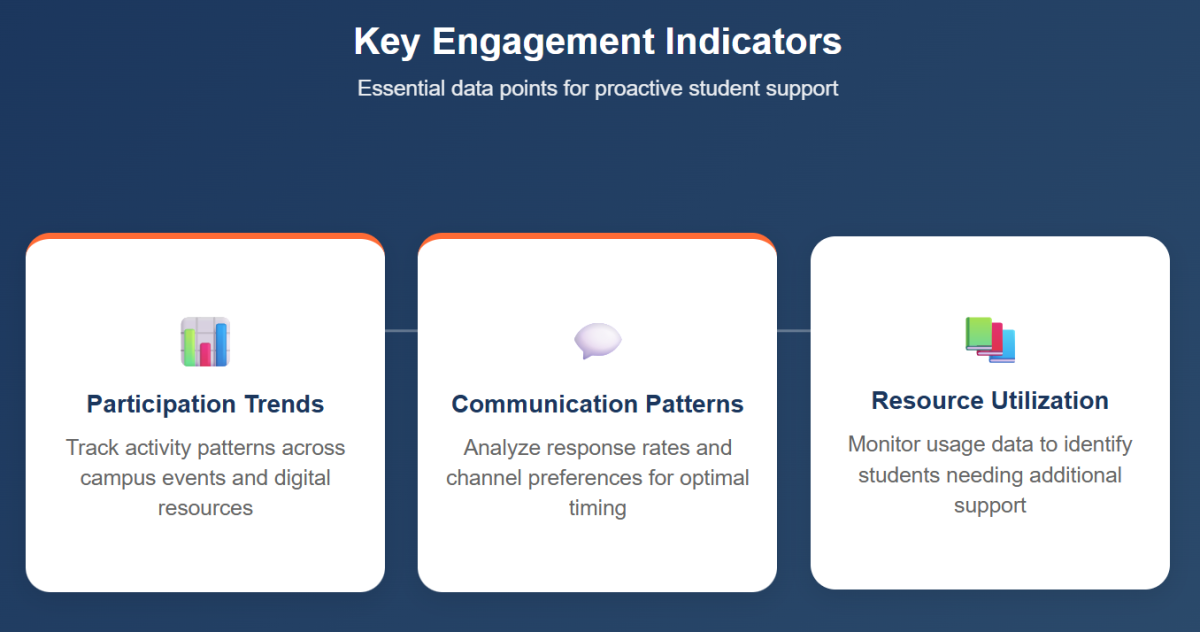
Key engagement indicators that enable proactive support include:
Participation trends across co-curricular activities that reveal declining campus connection before it affects academic performance
Communication preference patterns that inform optimal timing and channel selection for important messages
Resource utilization data that identifies students who might benefit from additional academic support services
Advanced platforms integrate this engagement data with academic systems, communication platforms, and administrative tools to provide comprehensive views of each student's journey. This integration enables personalized interventions delivered through appropriate channels at moments when students are most receptive to guidance.
Institutions leveraging these analytics capabilities report substantial improvements in their ability to maintain student connections throughout challenging periods. Rather than discovering issues after grades decline or attendance drops, staff receive actionable insights that enable meaningful conversations during regular interactions.
Integrated Communication Strategies That Guide Student Success
Effective proactive support requires communication systems that deliver relevant information through channels students actually use, at times when they're most likely to engage positively. Research indicates that personalized student experience initiatives significantly improve both satisfaction and retention when implemented strategically.
Modern communication platforms analyze response patterns, engagement history, and preference data to optimize message delivery across multiple channels. Text messaging for urgent notifications, email for detailed information, mobile app notifications for event reminders, and in-person conversations for complex guidance create comprehensive communication ecosystems that meet students where they are.
The most effective systems move beyond basic segmentation to create dynamic communication pathways that adapt based on individual student responses and behaviors. Students who consistently engage with digital resources receive different communication strategies than those who prefer face-to-face interactions, ensuring that every outreach effort maximizes the likelihood of positive engagement.
Strategic communication approaches include:
Behavioral trigger systems that automatically deliver relevant resources when students demonstrate specific engagement patterns
Preference learning algorithms that refine channel selection and timing based on individual response data
Contextual messaging that considers current academic status, upcoming deadlines, and personal circumstances
These sophisticated communication strategies enable institutions to guide students proactively through complex processes like course registration, career planning, and academic milestone completion. Rather than overwhelming students with generic information, targeted communications provide exactly the guidance each student needs at the most appropriate moments.

Connecting Academic Progress with Engagement Data for Better Outcomes
The most powerful proactive support systems integrate academic performance data with engagement analytics to create comprehensive pictures of student success factors. This integration enables institutions to identify correlation patterns between engagement behaviors and academic outcomes, facilitating early interventions that prevent academic difficulties before they impact grades or progression.
Students demonstrating decreased participation in campus activities often experience academic challenges weeks or months later. Communication response rates frequently predict successful course completion more accurately than traditional academic indicators alone. Understanding these connections enables institutions to provide targeted support during optimal intervention windows.
Advanced platforms correlate engagement data with academic milestones, financial aid status, career planning progress, and post-graduation outcomes to identify successful student journey patterns. These insights inform both individual student support strategies and institutional policy decisions that improve overall student success rates.
![Data visualization showing how integrated higher ed SaaS platforms connect academic, engagement, and communication data to predict student success patterns][image1]
Integration also enables more sophisticated resource allocation strategies. Rather than distributing support services equally across all students, institutions can focus intensive resources on students whose data patterns indicate higher intervention needs while providing automated guidance to students following successful trajectory patterns.
This data-driven approach to student support allocation improves both individual outcomes and institutional efficiency. Staff time gets directed toward students who will benefit most from personalized attention, while automated systems provide consistent guidance to students following typical success patterns.
Essential Features of Proactive Student Lifecycle Management Platforms
Institutions evaluating proactive higher ed SaaS solutions should prioritize platforms that offer comprehensive integration capabilities, sophisticated analytics tools, and flexible communication systems that work together seamlessly. The most effective solutions connect multiple aspects of the student experience into unified platforms that provide actionable insights across departments.
Core platform capabilities that enable proactive support:
Unified data integration that connects academic, engagement, financial, and communication systems into comprehensive student profiles
Real-time analytics dashboards that surface trends and patterns before they become critical issues requiring immediate intervention
Automated intervention systems that trigger appropriate responses based on predefined criteria and individual student patterns
Flexible communication tools that deliver personalized messages through optimal channels based on preference learning and engagement data
Collaborative workflow systems that enable cross-departmental coordination around individual student support strategies
The most successful implementations combine these technical capabilities with institutional commitment to data-driven decision making and proactive support philosophies. Technology alone cannot create proactive student support; institutional culture and staff training play equally important roles in successful outcomes.
Platforms that provide comprehensive staff training, change management support, and ongoing optimization assistance enable institutions to realize the full potential of proactive student engagement strategies. Investment in both technology and human capacity development ensures sustainable improvements in student success outcomes.
Best Practices for Implementing Proactive Engagement Systems
Successful implementation of proactive student support requires strategic planning that addresses technical integration, staff training, privacy considerations, and measurement frameworks. Institutions should approach these implementations systematically, beginning with clear objectives and building capabilities incrementally rather than attempting comprehensive transformation immediately.
Implementation strategies that maximize success:
Pilot programs that test proactive approaches with specific student populations before campus-wide deployment
Cross-departmental collaboration that ensures all stakeholders understand their roles in proactive support systems
Privacy framework development that maintains student trust while enabling effective data utilization for support purposes
Success metric definition that goes beyond traditional measures to include proactive intervention effectiveness and student satisfaction improvements
Data quality represents a critical foundation for effective proactive systems. Institutions must audit existing data sources, establish governance protocols, and ensure robust integration between different systems before deploying sophisticated analytics capabilities.
Staff development programs should emphasize interpreting analytics insights, having effective intervention conversations, and understanding when automated systems should escalate to human intervention. The most sophisticated technology fails when staff cannot translate insights into meaningful student interactions.
![Higher education staff collaborating around data dashboards showing predictive student engagement analytics and intervention opportunities][image2]
Change management becomes particularly important during these implementations because proactive approaches require different mindsets and workflows compared to traditional reactive support models. Staff accustomed to responding to problems must learn to anticipate needs and initiate conversations before issues become critical.
Measuring Success in Proactive Student Engagement
Evaluating the effectiveness of proactive student support requires measurement frameworks that capture both traditional outcomes and new indicators specific to anticipatory interventions. Institutions should track engagement improvements, intervention success rates, staff efficiency gains, and student satisfaction changes alongside traditional retention and completion metrics.
Recent research from the National Student Clearinghouse Research Center shows that institutions focusing on proactive student success strategies throughout the entire academic lifecycle see measurable improvements in multiple outcome areas.
Their 2024 data reveals persistence rates reached 76.5% and retention rates hit 68.2% - both the highest levels in a decade. These improvements often become apparent within the first academic year of implementation as systems begin identifying and addressing challenges before they impact student progression.
Key performance indicators for proactive systems include intervention timing effectiveness, communication response rate improvements, resource utilization optimization, and early warning system accuracy. These metrics provide insights into how well predictive capabilities are functioning and where refinements might improve outcomes.
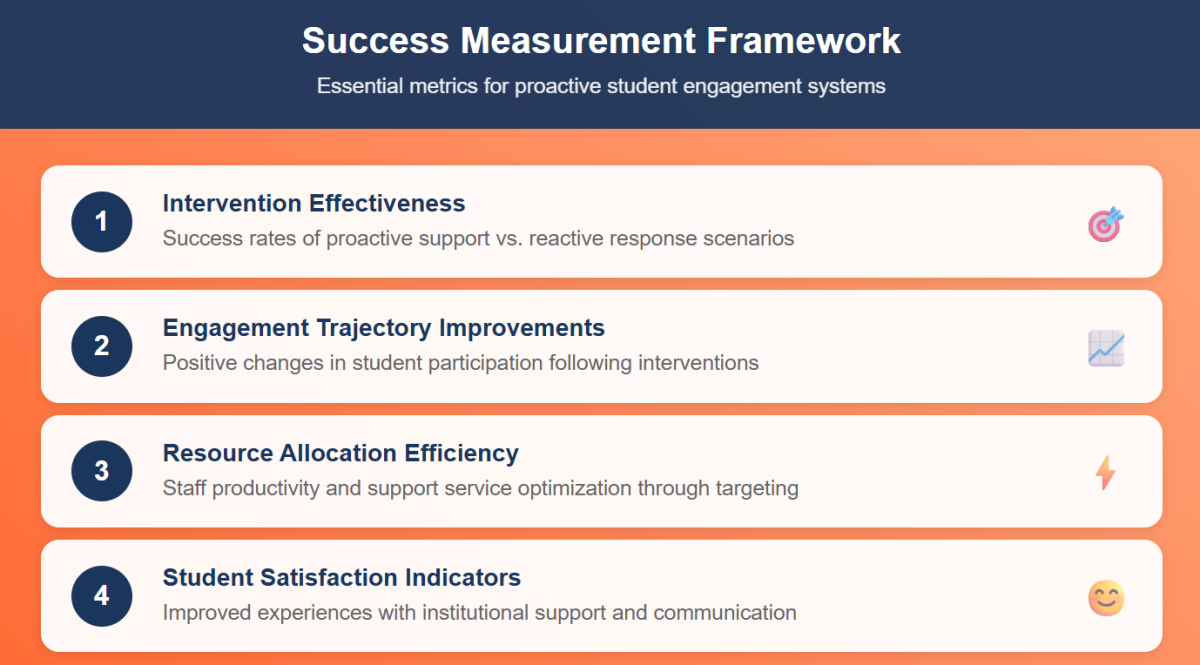
Essential measurement categories:
Intervention effectiveness measured by successful outcome rates when proactive support is provided compared to reactive response scenarios
Engagement trajectory improvements that demonstrate positive changes in student participation patterns following targeted interventions
Resource allocation efficiency showing improved staff productivity and support service utilization through predictive targeting
Student satisfaction indicators reflecting improved experiences with institutional support and communication systems
Long-term outcome tracking reveals the cumulative impact of proactive approaches on institutional goals like retention, completion, and post-graduation success. These longer-term measures validate the investment in sophisticated support systems and inform ongoing optimization efforts.
The Future of Predictive Student Support Technology
Emerging technologies continue expanding what's possible in proactive student support, with artificial intelligence, machine learning, and advanced analytics creating new opportunities for anticipating and addressing student needs. Natural language processing enables more sophisticated analysis of communication patterns, while predictive modeling becomes increasingly accurate as systems accumulate more historical data.
Integration capabilities are expanding to include external data sources that provide additional context for student support decisions. Social determinants of success, local economic conditions, and industry employment trends increasingly inform institutional strategies for supporting student achievement and career preparation.
The most forward-thinking institutions are positioning themselves to leverage these advancing capabilities by establishing strong data foundations, developing staff expertise in analytics interpretation, and creating institutional cultures that prioritize proactive student support approaches.
![Futuristic visualization of AI-powered higher ed SaaS platforms analyzing student data patterns to predict and prevent academic challenges][image3]
As these technologies mature, the distinction between reactive and proactive approaches will become even more pronounced. Institutions that invest in sophisticated student lifecycle management software and develop expertise in predictive engagement strategies will maintain significant advantages in student satisfaction, retention, and overall institutional effectiveness.
Frequently Asked Questions
How do proactive higher ed SaaS solutions differ from traditional student information systems? Proactive platforms integrate data across multiple systems to identify patterns and trends before problems occur, enabling early interventions and personalized support rather than simply storing and retrieving student information reactively.
What privacy considerations are important when implementing predictive student engagement systems? Institutions must ensure FERPA compliance, obtain appropriate consent for data analysis, provide transparent communication about how student data improves support services, and implement robust security measures while maintaining the analytics capabilities that enable effective proactive support.
How long does it typically take to see results from proactive student engagement implementations? Most institutions notice improvements in engagement metrics within one semester, with more significant retention and satisfaction improvements becoming apparent after a full academic year as systems accumulate sufficient data to refine their predictive capabilities.
What staff training is required for effective proactive student support? Successful implementations require training for advisors, student services personnel, and administrative staff on interpreting analytics insights, conducting proactive intervention conversations, and understanding when to escalate automated recommendations to human support.
Transforming Student Success Through Proactive Engagement
The evolution from reactive to proactive student support represents more than a technological upgrade; it embodies a fundamental shift toward anticipating and addressing student needs before they become barriers to success. Institutions implementing sophisticated student lifecycle management software with integrated analytics and communication capabilities position themselves to deliver the personalized student experience that modern learners expect and deserve.
Success requires investment in comprehensive platforms that connect academic, engagement, and communication data into actionable insights for staff and automated support systems. Equally important is institutional commitment to data-driven decision making, proactive support philosophies, and ongoing optimization based on student feedback and outcome measurement.
The future belongs to institutions that can anticipate student needs, deliver timely interventions, and create seamless experiences throughout the academic journey. Modern Campus provides the integrated platform and expertise necessary to transform your approach to student engagement from reactive responses to proactive success strategies.