
Frost & Sullivan Released Report: "2025 White Paper on the Current Landscape and Future Trends of the Mitochondrial Medicine Industry"
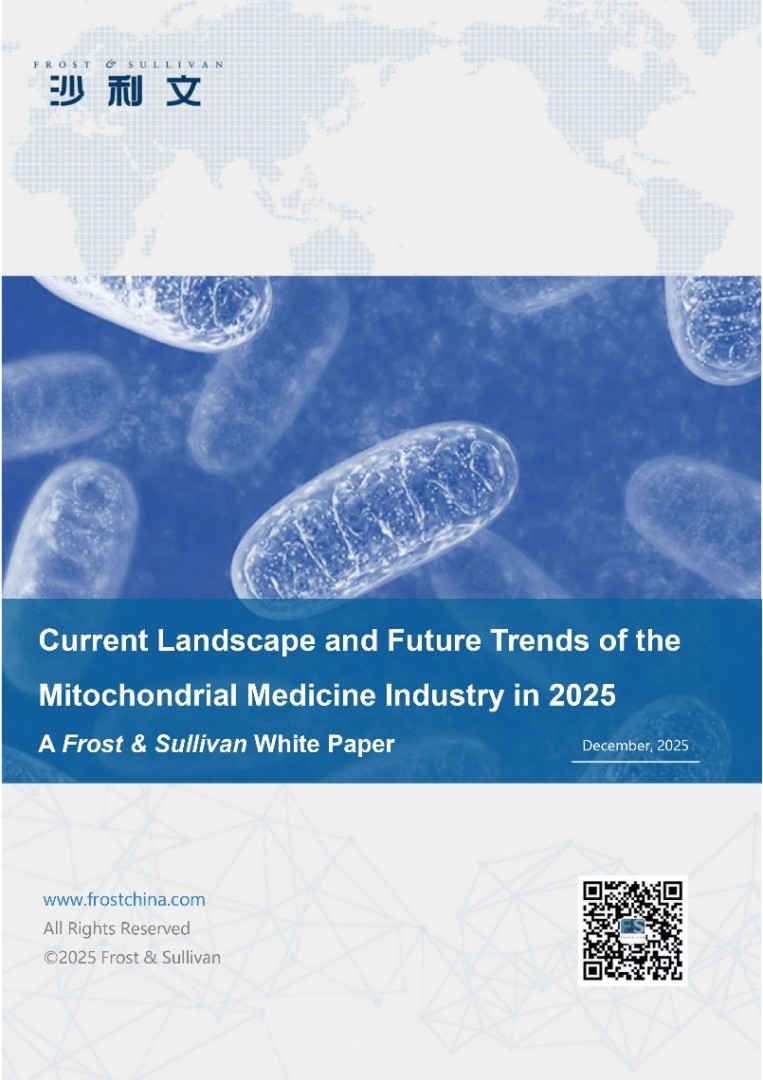
Frost & Sullivan has released the “2025 White Paper on the Current Landscape and Future Trends of the Mitochondrial Medicine Industry” (hereinafter referred to as the “White Paper”). The White Paper focuses on the field of mitochondrial medicine, delving into its core development trajectory and providing a comprehensive analysis of the current industry landscape, including key elements such as technological R&D progress, clinical applications, market size, and growth trends. At the same time, it systematically examines future development directions, offering scientific and structured strategic references for corporate decision-makers, policymakers, and investors in the mitochondrial medicine sector. The White Paper aims to help stakeholders gain in-depth insights into the mitochondrial medicine industry environment, clarify the competitive landscape and identify emerging market opportunities and future trends.
(To read the White Paper, go here: https://hub.frost.com/current-status-and-trends-of-mitochondrial-medicine-industry/)
Abstract
The research foundation of mitochondrial medicine stems from over a century of scientific exploration. Since the late 19th century, when mitochondria were first discovered and named, through the mid-20th century, when the concept of mitochondrial diseases was established, to 2013, when Cell identified “mitochondrial dysfunction” as a hallmark of aging, the focus of mitochondrial medicine has expanded from the narrow domain of classical mitochondrial diseases to a broader spectrum of conditions associated with mitochondrial dysfunction. As research into aging mechanisms has deepened, it has become clear that mitochondrial dysfunction is closely linked to the aging process. Accumulation of mitochondrial damage can lead to disrupted cellular energy metabolism, excessive reactive oxygen species (ROS) production, and accelerated apoptosis, collectively driving organismal aging.
Mitochondrial medicine, through advanced approaches such as precise regulation of mitochondrial physiological functions, restoration of mitochondria–nucleus communication, and promotion of mitochondrial biogenesis, aims to delay aging and treat aging-related diseases. It may improve the quality of life for populations with diverse anti-aging needs and extend healthy lifespan. In the vast blue ocean of the anti-aging market, mitochondrial medicine is demonstrating significant development potential, driven by its innovative diagnostic and therapeutic concepts and outstanding clinical applications, attracting the attention of global research institutions, healthcare companies, and investors, and emerging as one of the most promising future tracks in the health sector.
Among various research directions, mitochondrial drug development is progressing rapidly and is highly representative of the field. In recent years, targeting NAD? metabolism has become a hallmark of mitochondrial drug research and has received widespread attention. From preclinical research to clinical translation, targeting NAD? metabolism has shown enormous potential in delaying aging and treating aging-related diseases. Meanwhile, the scope of mitochondrial medicine research continues to expand, evolving from drug development alone to the construction of a full-cycle service ecosystem encompassing diagnosis, treatment, and health management. Through these efforts, mitochondrial medicine is gradually establishing a comprehensive scientific intervention system for healthy lifespan, providing novel solutions for humanity’s pursuit of youth and wellness, and guiding the anti-aging industry toward a more scientific, precise, and efficient future.
“2025 White Paper on the Current Landscape and Future Trends of the Mitochondrial Medicine Industry” highlights the following:
- Overview of Mitochondrial Medicine: Definition of mitochondria and mitochondrial medicine, history of mitochondrial medicine and its key technologies, as well as an overview of the current mitochondrial medicine industry.
- Current Landscape of the Mitochondrial Medicine Industry: Detailed insights into the global/China population landscape, supportive policies, disease burden related to the mitochondrial medicine industry, end-user market demand for mitochondrial medicine, and the mitochondrial medicine industry ecosystem.
- Mitochondrial Medicine Industry Players: Introduction to current major Global and Chinese industry players in the mitochondrial medicine Industry, including their products and pipelines related to mitochondrial medicine.
- Future Trends of the Mitochondrial Medicine Industry: The global and domestic future trends, blue ocean outlook, and market potential of the mitochondrial medicine industry.
Mitochondrial Medicine Industry Overview
Mitochondria are essential for cellular energy production and many vital processes, including fatty acid metabolism and calcium homeostasis. NAD?, a key molecule in mitochondrial function, declines with age, leading to mitochondrial dysfunction and contributing to diseases like cardiovascular and neurodegenerative disorders.
Mitochondrial medicine is an emerging interdisciplinary field focused on advancing disease diagnosis, prevention, and treatment by uncovering how mitochondrial physiology and dysfunction contribute to the onset and progression of illness. Many human diseases are now recognized to involve compromised mitochondrial health—whether as the direct result of primary mitochondrial defects or as secondary damage arising during disease development. This strong association places mitochondrial medicine at the forefront of predictive, preventive, and personalized healthcare, supporting a transition from reactive medical practice to approaches centered on risk assessment, targeted prevention, and individualized therapies.
Key technologies in mitochondrial medicine continue to make breakthroughs, including mitochondrial isolation and purification, genetic testing, multi-omics technologies, biomarker detection, gene therapy, and cell therapy. These technologies provide crucial support for research on mitochondrial function, as well as for the diagnosis and treatment of mitochondrial diseases.
Current Landscape of Mitochondrial Medicine
- The Impact of Population Aging on Mitochondrial Medicine
The growing aging population is a major driver of demand for mitochondrial medicine. Both globally and in China, population structures are undergoing profound shifts, with declining birth rates and population aging becoming irreversible long-term trends. Simply extending lifespan is no longer sufficient to meet societal needs. People’s health perceptions are shifting from the pursuit of “living longer” to the pursuit of “living better.” Increasingly, the focus is not on the length of life itself, but on how to maintain physical function, cognitive ability, and quality of life over a longer period of time. Mitochondrial medicine, which enables early assessment and precise intervention by targeting the cell’s energy factories and core aging mechanisms, has emerged as a key approach to promoting healthy aging, driving sustained growth in market demand.
- Policy Support and Market Demand
China’s policy initiatives, including the Healthy China 2030 plan and national strategies addressing population aging, have created a favorable environment for the development of mitochondrial medicine. Mitochondrial research has been a major focus of the National Natural Science Foundation of China, with steadily growing funded projects and a top-three ranking among medical research areas in recent years. Current research centers on mitochondria’s roles in cellular homeostasis and disease, focusing on five areas: mitochondrial biology, disease associations, dynamics, quality control, and regulation of aging.
- Disease Burden Related to the Mitochondrial Medicine Industry
Mitochondrial dysfunction is one of the core pathological mechanisms underlying various aging-related chronic diseases, covering multiple fields such as cardiovascular diseases, immunosenescence, neurodegenerative diseases, metabolic diseases, reproductive system diseases, and age-related ophthalmic diseases. The White Paper analyzes the specific associations between mitochondrial dysfunction and each of these indications, and elaborates on the potential of alleviating or treating these conditions by improving mitochondrial function.
Future Trends in Mitochondrial Medicine
- Global Development Trends: Technological Breakthroughs and Increasing Standardization
Continuous technological advancement is driving the global field of mitochondrial medicine. Cutting-edge approaches, such as mitochondrial transplantation, gene therapy, and cell therapy, are steadily expanding their clinical applications. Meanwhile, artificial intelligence and machine learning are being increasingly incorporated into disease diagnosis and treatment, accelerating the shift toward more precise and efficient medical solutions. At the same time, intensifying market competition is prompting companies to prioritize technological innovation and product quality. Governments worldwide are strengthening regulatory oversight to safeguard patient safety and maintain market order, contributing to a higher degree of industry standardization. Growing international collaboration is facilitating the exchange of knowledge and technology, while consumers are becoming increasingly attentive to product compliance and regulatory transparency.
- Domestic Development Trends: Regulatory Support and Market Demand
Domestic policies are steadily supporting the industry’s growth. National strategies such as Healthy China 2030 and the 14th Five-Year Plan prioritize addressing population aging, while multiple policies promote the anti-aging sector and the health consumption market, creating strong momentum for mitochondrial medicine. Rising health awareness and upgrading consumer demand are driving the market toward more refined and personalized mitochondrial services, prompting companies to move from standardized products to customized solutions. With ongoing innovation, especially the integration of multi-omics, AI, and big data, the market will continue to expand and diversify in its applications.
- Market Potential of Mitochondrial Medicine Industry
Mitochondrial medicine is still in its developmental stage, but its future market potential is substantial.
In the clinical applications sector, clinical research is rapidly advancing across major disease areas, including cardiovascular, neurodegenerative, metabolic, reproductive, and aging-related diseases, with some targeted drugs already commercialized.
In the health-related consumption sector, China’s large and aging population is driving strong, tiered demand for anti-aging and wellness solutions across age groups.
- Blue Ocean Opportunities
In the clinical application sector, mitochondrial medicine is shifting from symptomatic treatment to curative interventions for diseases linked to mitochondrial dysfunction. Advances in gene editing, novel delivery systems, and mitochondrial transplantation are accelerating its applications in areas such as cardiovascular and neurodegenerative diseases. These innovations improve targeting and safety while offering new solutions for complex conditions and addressing significant unmet clinical needs.
In the health-related consumption sector, mitochondrial applications are evolving from broad, general services to precise, customized solutions that address consumer needs such as boosting energy, reducing fatigue, slowing aging, and improving metabolism. As health awareness and anti-aging demand grow, innovations in mitochondrial function testing, targeted nutrition, and cellular-level repair are driving the market toward higher value-added services. Integrated with intelligent tools and big data, personalized health management now offers a closed-loop system of testing, intervention, and continuous monitoring, forming a new consumer ecosystem centered on vitality, healthy aging, and extended healthspan.
About Frost & Sullivan
Frost & Sullivan, the Growth Partnership Company, works in collaboration with clients to leverage visionary innovation that addresses the global challenges and related growth opportunities that will make or break today's market participants. For more than 60 years, Frost & Sullivan has been developing growth strategies for the global 1000, emerging businesses, the public sector, and the investment community.
Information contained on this page is provided by an independent third-party content provider. XPRMedia and this Site make no warranties or representations in connection therewith. If you are affiliated with this page and would like it removed please contact [email protected]
